At Sri Harini Rubber Products, we work with a wide range of rubber compounds and engineering
plastics to meet different application, temperature, and performance requirements.
Each material is carefully selected and can be custom-formulated based on customer needs
such as hardness, flexibility, chemical resistance, and durability.
Our raw materials are broadly classified into:
Select a rubber material to view its properties, temperature range, and capabilities.
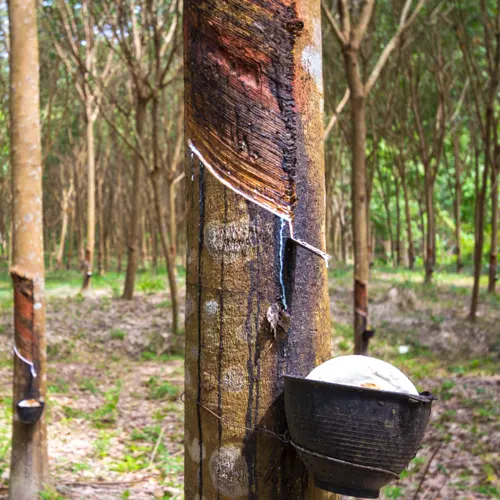
Natural Rubber is derived from natural latex and is known for its excellent elasticity and resilience.
NBR is widely used for oil and fuel resistant applications.
EPDM is specially designed for outdoor and weather-resistant applications.
Neoprene offers a balanced performance between oil resistance and weather resistance.
Silicone rubber is known for its extreme temperature stability.
FKM is a high-performance fluoroelastomer for extreme environments.
HNBR is a hydrogenated version of NBR, offering higher strength and heat resistance.
FFKM is an ultra-high-performance rubber for extreme chemical and temperature conditions.
SBR is a versatile and cost-effective synthetic rubber widely used for general-purpose applications, offering good abrasion resistance and reliable mechanical performance.
Engineering plastics are rigid, strong, and dimensionally stable materials, used where rubber flexibility is not required.
Precision-engineered rubber compounds designed to perform under demanding conditions.
Shore A hardness precisely matched to functional requirements.
Formulations optimized for high and low temperature performance.
Enhanced resistance to oils, fuels, and aggressive chemicals.
Compounds engineered for durability and long-term reliability.
Each compound is custom-developed to meet exact application demands, compliance standards, and operating environments.
Contact Technical TeamPerformance comparison across key environmental and mechanical properties.
| Material | Oil Resistance |
Weather / UV |
Heat Resistance |
Low Temp Flexibility |
Abrasion / Wear |
Chemical Resistance |
|---|---|---|---|---|---|---|
| Natural Rubber (NR) | 🔴 | 🔴 | 🟡 | 🟢 | 🟢 | 🔴 |
| SBR | 🔴 | 🔴 | 🟡 | 🟡 | 🟢 | 🔴 |
| Nitrile Rubber (NBR) | 🟢 | 🟡 | 🟡 | 🟡 | 🟢 | 🟡 |
| EPDM | 🔴 | 🟢 | 🟢 | 🟢 | 🟡 | 🟡 |
| Neoprene (CR) | 🟡 | 🟢 | 🟡 | 🟡 | 🟡 | 🟡 |
| Silicone Rubber | 🔴 | 🟢 | 🟢 | 🟢 | 🔴 | 🟡 |
| Viton® / FKM | 🟢 | 🟢 | 🟢 | 🟡 | 🟡 | 🟢 |
| HNBR | 🟢 | 🟢 | 🟢 | 🟢 | 🟢 | 🟡 |
| FFKM | 🟢 | 🟢 | 🟢 | 🟡 | 🟡 | 🟢 |
Operating temperature ranges for common rubber materials
| Material | Min Temp | Max Temp | Operating Range |
|---|---|---|---|
| Natural Rubber (NR) | –50°C | +80°C |
|
| SBR | –40°C | +100°C |
|
| Nitrile Rubber (NBR) | –30°C | +120°C |
|
| EPDM | –40°C | +150°C |
|
| Neoprene (CR) | –35°C | +120°C |
|
| Silicone Rubber | –60°C | +230°C |
|
| Viton® / FKM | –20°C | +250°C |
|
| HNBR | –40°C | +150°C |
|
| FFKM | –20°C | +325°C |
|
Find quick answers to common questions about our rubber materials, applications, and customization process.